How platforms detect near-duplicate images and video
Large platforms detect near-duplicate media with perceptual hashing. Meta's published family: PDQ (256-bit image hashes compared by Hamming distance), TMK+PDQF (fixed-length whole-video signatures), vPDQ (frame-level hashing that matches clips lifted out of longer videos) and SimSearchNet++ (a self-supervised CNN resilient to crops, blurs and screenshots).
CLAIMS CARRY THEIR CONFIDENCE: DOCUMENTED = STATED BY THE PLATFORM OR IN A CITED PUBLIC SOURCE ·INFERENCE = REASONABLE DEDUCTION, NOT CONFIRMED · UNKNOWN = NOT PUBLIC, SAID SO INSTEAD OF GUESSED
The systems Meta has actually published
Unlike most detection layers, this family is open source and documented — there is no need to speculate. DOCUMENTED
| System | Matches | Key property |
|---|---|---|
| PDQ | Images | 256-bit perceptual hash, compared by Hamming distance |
| TMK+PDQF | Whole videos of the same length | ~256KB fixed-length signature — lookup is near-constant-time at index scale |
| vPDQ | Clips lifted out of longer videos | Frame-level PDQ; matches on the proportion of shared similar frames — built to catch subsequences |
| SimSearchNet++ | Near-duplicate images | Self-supervised CNN, deployed on images uploaded to Facebook and Instagram; resilient to crops, blurs and screenshots |
vPDQ is the one that matters conceptually: TMK assumes same-length videos, but vPDQ was built specifically to match a subsequence — a clip taken from a longer source. Sub-clipping is an anticipated input to this family, not a counter to it. DOCUMENTED
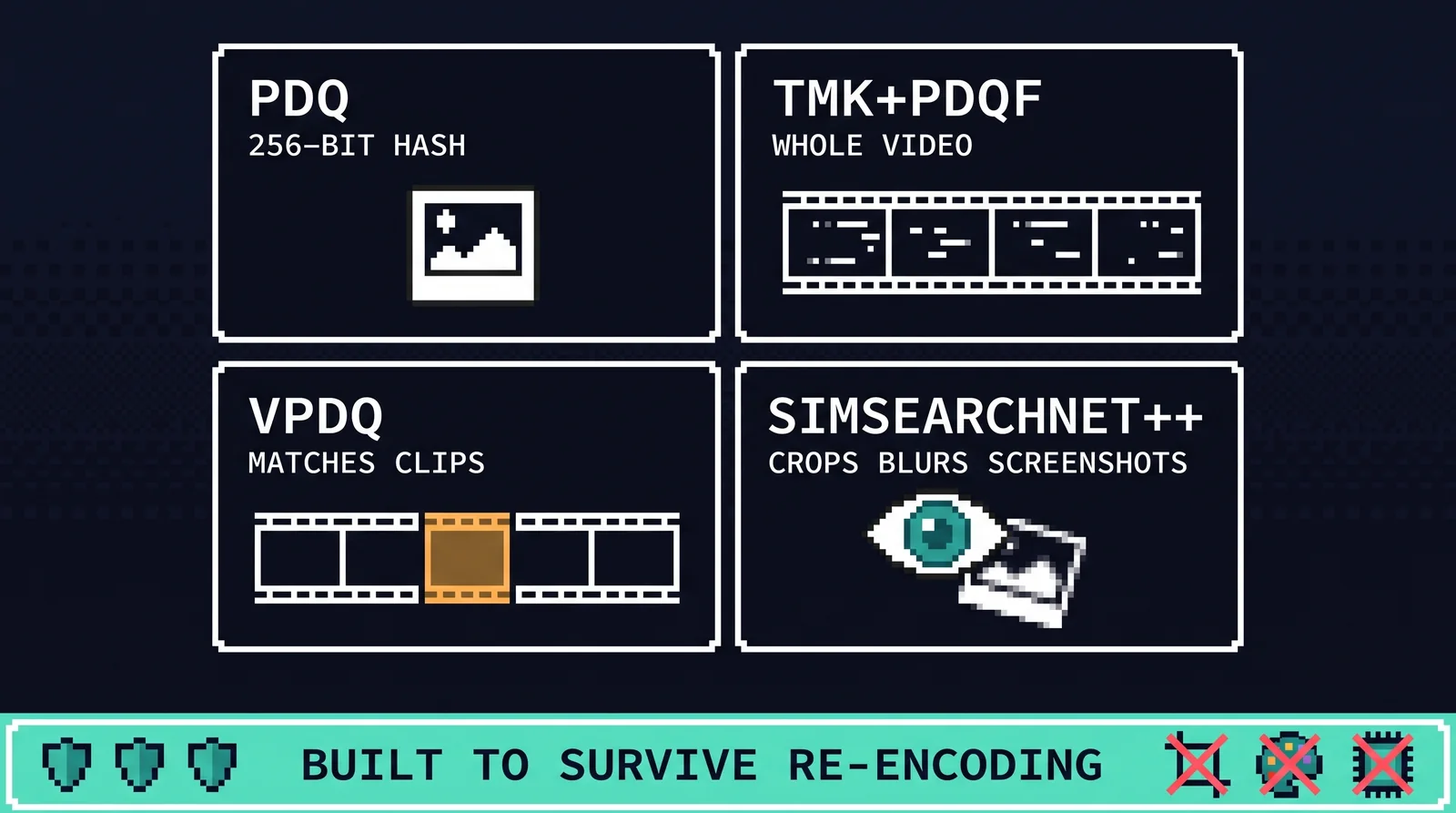
These systems were engineered to survive editing
The folk theory says re-encoding, cropping, rescaling or color-shifting a file "breaks the hash." The published record points the other way. Meta states SimSearchNet++ is resilient to "crops, blurs, and screenshots," and describes its rights fingerprinting as surviving compression, cropping, resizing and minor edits. DOCUMENTED
The reason is who these systems were built to catch. PDQ, TMK+PDQF and vPDQ were developed and open-sourced for Trust & Safety hash-sharing between platforms — child-safety and terrorist content — where adversaries re-encode aggressively as a matter of course. Codec swaps and ±10% crops are the baseline threat model of this family, not an edge case. A pipeline that transforms files to slip past perceptual matching is optimizing against systems whose entire design brief was surviving exactly those transformations.
The part nobody tells you: it fires silently
Day to day, near-duplicate indexing is not primarily a punishment system — its output feeds deduplication, ranking and labelling. You are not notified when it fires. Content that is quietly deduplicated or down-weighted looks identical, from the outside, to content that simply did not perform. DOCUMENTED (the systems' stated purposes) ·INFERENCE (the no-notification experience)
An honest caveat about Rights Manager
The published hashing family and Rights Manager's copyright fingerprinting are not documented as the same system — Rights Manager's algorithm has never been disclosed. That Meta reuses this technology there is a reasonable engineering deduction, and it stays labelledINFERENCE until Meta says otherwise. Production match thresholds and Hamming-distance cutoffs are UNKNOWN.
What publishers should actually do
- Stop treating matching as an adversary. The winning move is to publish content you hold the rights to publish — owned, licensed, or partnership-cleared — so a match, if it happens, resolves in your favor instead of against you.
- Carry your provenance honestly. Preserve credentials and metadata through your encode pipeline rather than stripping them; authenticity signals are becoming inputs to labelling.
- Design for the silence. Because this layer never notifies, unexplained underperformance of derivative content is a signal worth reading — measure originality at the account level instead of debugging individual files.
Sources
- facebook/ThreatExchange — PDQ, TMK+PDQF and vPDQ reference implementations; vPDQ documentation
- The TMK+PDQF video-hashing algorithm and the PDQ image-hashing algorithm (Meta's published paper)
- Meta AI — SimSearchNet and SimSearchNet++ announcements