How Meta Rights Manager actually works
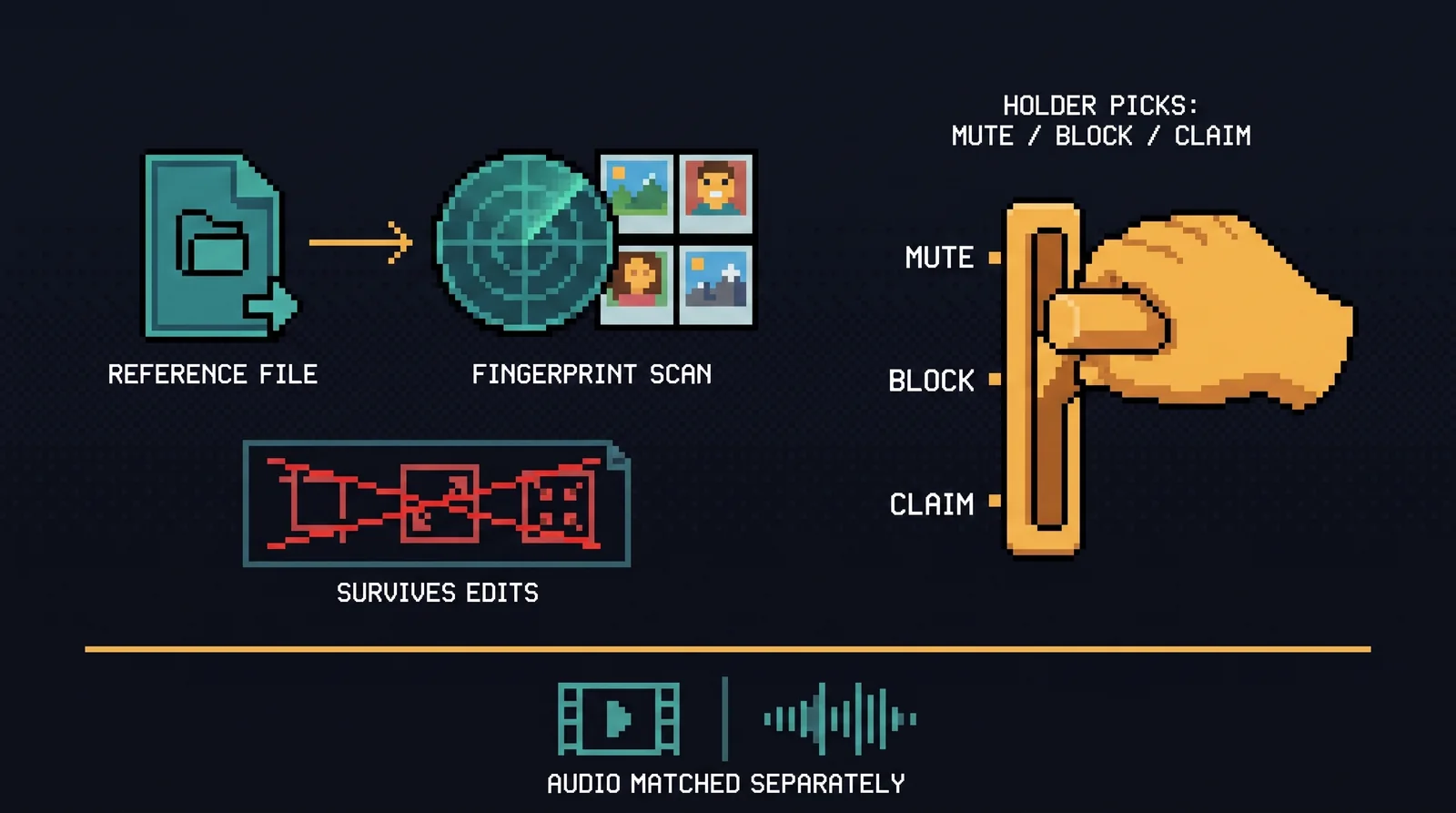
Rights Manager is Meta's rights-enforcement product for Facebook and Instagram — application-gated, not open to every user: a rights holder uploads a reference file, Meta generates a fingerprint and continuously scans uploads against the reference library, matches survive compression, cropping, resizing and minor edits, and the rights holder — not Meta — chooses the action.
CLAIMS CARRY THEIR CONFIDENCE: DOCUMENTED = STATED BY THE PLATFORM OR IN A CITED PUBLIC SOURCE ·INFERENCE = REASONABLE DEDUCTION, NOT CONFIRMED · UNKNOWN = NOT PUBLIC, SAID SO INSTEAD OF GUESSED
The mechanics: reference files and a continuous scan
A rights holder who has been granted access — it is application-based — uploads areference file for a specific work. Meta fingerprints it and continuously scans uploads across Facebook and Instagram against the reference library. Meta's own wording: the fingerprint recognises matching content "even if users alter the file through compression, cropping, resizing, or minor edits." DOCUMENTED
Two things follow that most operations get backwards. First, protection only exists for works that are actually in the library — enforcement is per-work, not per-owner. Second, editing a file to dodge the match is fighting a system whose stated design point is surviving those edits. DOCUMENTED (the resilience claim) ·INFERENCE (the futility reading)
The rights holder holds the lever
When a match fires, the rights holder chooses the action, not Meta — monitor, claim, block, or (for audio) mute. DOCUMENTED For a publisher this means outcomes are not uniform: the same matched clip can be tolerated by one owner and account-ending with another, and the difference is policy on their side of the table, invisible from yours.
Audio is its own jurisdiction
- Audio is fingerprinted and matched independently of video — which is why a Reel can keep its picture and lose its sound. DOCUMENTED
- Licences are per-platform and per-territory. A track cleared on one platform may be blocked on another; cleared in one country, blocked in the next. DOCUMENTED
- Enforcement is retroactive. A published Reel can lose its audio later if a licence changes, surfaced as "Audio unavailable." Published ≠ cleared. DOCUMENTED
- Meta describes 2026 improvements extending audio detection to short background segments and AI-generated audio. DOCUMENTED
What this means for an automated publisher
- Scope rights by track, platform and territory — not by "the video is cleared." The failure mode this system punishes hardest is cleared footage carrying uncleared music.
- Treat published content as still-enforceable. Retroactive audio loss means a rights ledger has to keep watching after launch, not just before it.
- Hold proof, not vibes. Because the holder picks the action, your only stable defence is title you can produce — the reason rights are a launch gate in this system's counterpart, not a support ticket.
Sources
- Rights Manager for Instagram — Meta Business Help Center; Reference Files in Rights Manager; Eligibility; Requesting access
- Confidence markers follow the Altineris research discipline: a number or claim without a citation is treated as a fabrication.