Article 17, stay-down, and the EU appeal weapon
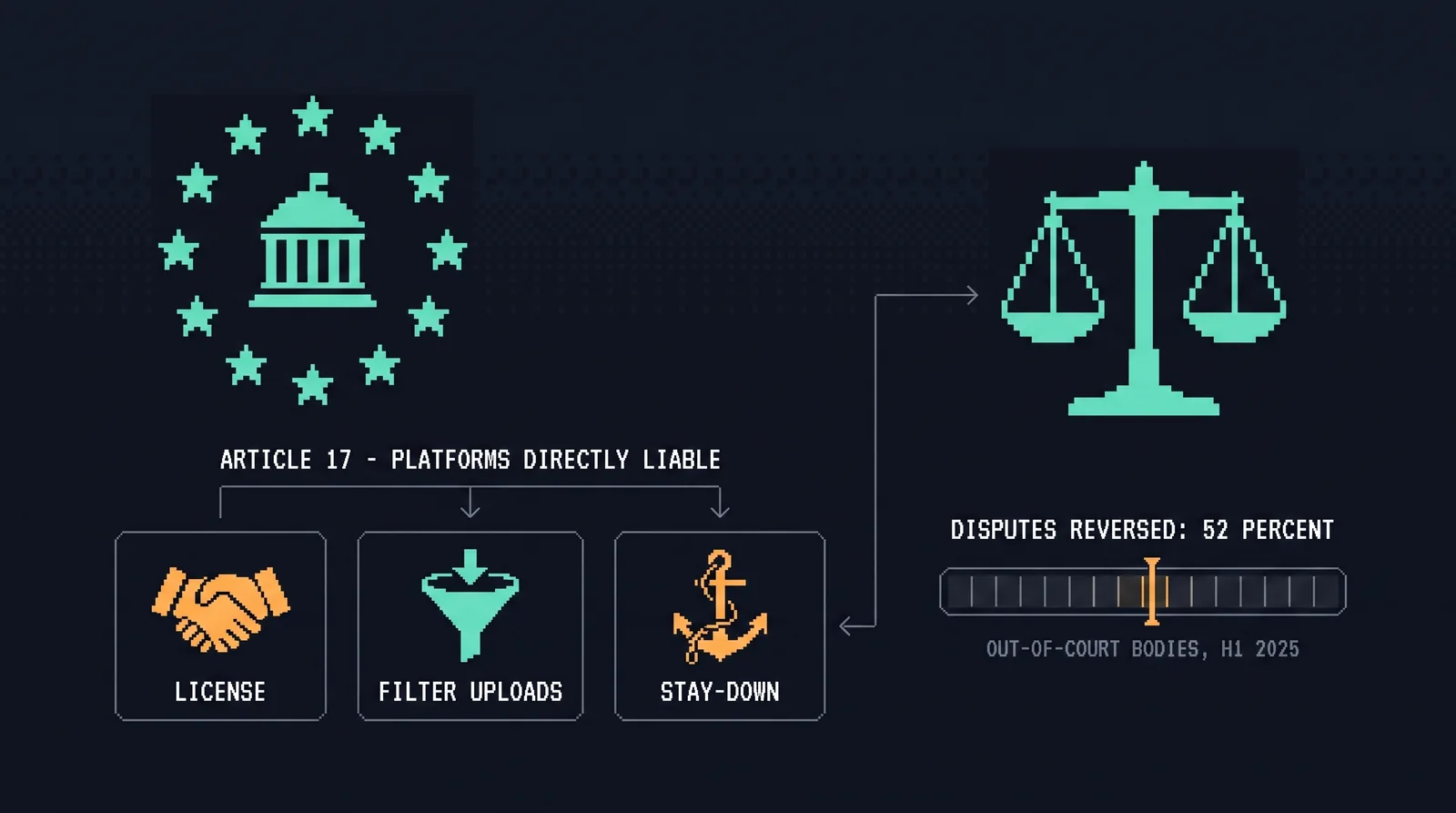
The EU's DSM Directive Article 17 makes for-profit content-sharing platforms directly liable for copyright-infringing uploads unless they make cumulative best efforts to license, filter uploads, and honor notice-and-stay-down — so in Europe, better content matching is a legal obligation on the platform, not a product choice. The same regulatory package hands publishers a weapon: DSA out-of-court dispute bodies reversed 52% of the platform decisions they closed in the first half of 2025.
CLAIMS CARRY THEIR CONFIDENCE: DOCUMENTED = STATED BY THE PLATFORM OR IN A CITED PUBLIC SOURCE ·INFERENCE = REASONABLE DEDUCTION, NOT CONFIRMED · UNKNOWN = NOT PUBLIC, SAID SO INSTEAD OF GUESSED
Article 17: liability unless best efforts
Article 17 strips the safe-harbour immunity platforms previously held and makes themdirectly liable for infringing user uploads — unless they make cumulative "best efforts" on three fronts: DOCUMENTED
| Obligation | Effect in practice |
|---|---|
| (a) Obtain authorisation | Licensing deals with rights holders |
| (b) Ensure unavailability of specific protected content | Upload filtering |
| (c) Notice-and-takedown and notice-and-stay-down | A single notice converts into a persistent block on re-uploads of that work |
Stay-down is the consequential one. Once a rights holder notifies a platform about a work, the platform must use best efforts to prevent it being uploaded again — a one-time takedown becomes a standing obligation. And the CJEU has upheld Article 17 as compatible with freedom of expression: this is settled law, not a pending proposal. DOCUMENTED
The structural consequence for publishers: in the EU, detection quality is a liability defence for the platform. Anyone whose strategy assumes matching infrastructure will stay weak is betting against a legal requirement that it get stronger.DOCUMENTED (the obligation) · INFERENCE (the bet framing)
The weapon: DSA dispute settlement
The same regulatory package created something publishers barely use. DSA Article 21out-of-court dispute settlement explicitly covers content takedowns, demonetization, account suspensions, and decisions to leave flagged content up. DOCUMENTED
The outcome data is striking: in the first half of 2025, out-of-court settlement bodies reviewed over 1,800 disputes involving Facebook, Instagram and TikTok and reversed the platform's decision in 52% of closed cases — one body overturned more than three-quarters of the decisions it reviewed. DOCUMENTED For an EU publisher, a wrongful takedown or suspension is not the end of the conversation; it is the start of a process that, on the recorded numbers, favors the challenger about half the time.
What this means for an automated publisher
- Build stay-down as data, not memory. A notified work must never resurface from any account you operate — in the EU that expectation has statutory backing on the platform's side, and your own blocklist is how you never test it.
- Track appeal state as first-class. Suspensions and takedowns in the EU carry formal dispute rights with real reversal rates — a pipeline should surface where each decision stands rather than treating enforcement as final.
- Read the two jurisdictions together. The US front (§512 repeat-infringer) and the EU front (Article 17 stay-down) point the same direction: rights proven before launch is the only position that survives both.
Sources
- Guidance on Article 17 of Directive 2019/790 — EUR-Lex; CJEU backs Article 17 — Pinsent Masons; The Post-DSM Copyright Report — COMMUNIA
- DSA — statements of reasons; The first DSA out-of-court dispute settlements — Stanford Cyberlaw (the 1,800-dispute / 52% reversal data)
- This guide describes statute, case law and published outcome data; it is not legal advice.